The Frequency of Leadership: Personal Equity in a Noisy World
By Meg Charles, Co-Founder, Basswood Counsel | Creator, Personal Equity Framework
This article for growth-stage founders & C-suite executives is adapted from her presentation at Liberty Ventures' Prospera, Honduras Gathering- February 5-9, 2026
Whose dream are you living?
The answer to that question was both terrifying and liberating. Terrifying—because I knew the answer would require change before my mind could negotiate it away. Liberating—because once you tell yourself the truth, you can’t unhear it. I'm an American-born daughter of Haitian immigrants. In my family, the path to the American dream was unspoken yet clear — doctor, lawyer, engineer. These weren't just careers. They were proof. Proof that the American Dream is achievable. Proof of status, security, and stability. Success wasn't a just a personal aspiration, it was a communal obligation. Expected. Assumed. Rarely celebrated. So I learned early: achievement was the price of worthiness. And I achieved. Ivy League university. Top-tier law school. Equity partner by 32. Successful on paper. Hollow in my body. Here's what nobody tells high achievers: high achievement and deep alignment are not the same thing. And your body knows the difference long before your mind catches up. Understanding who I am — and aligning with that truth to define success on my own terms — took considerably longer than earning the degrees. What I know now is simple: I'm a bridge builder. I build the bridge between who you are on the inside and the value you create in the world; between insight and action; confusion and clarity. That realization is the foundation of the Personal Equity Framework I'm called to share with you.
Signal vs. noise: the hidden leadership problem
And here's the obligation that comes with leadership: to build a structurally sound bridge between who you are and the value you are creating in the world. If the bridge between who you are and the value you're building aren't aligned, then your bridge is structurally unsound and the cracks won't stay hidden. You may get traffic across it for a while. You may even look successful from the outside. But a misaligned bridge doesn't just wobble. Under enough weight, it crumbles. And as you scale your company, you're adding weight every single day — more people, more decisions, more stakes. Everything gets amplified, including the cracks. 1 Aligning who you are with the value you create isn't just personal development. It's structural engineering for leading your company. THE PERSONAL EQUITY FRAMEWORK That's precisely why I distilled everything I've learned — from the hollowness, the realignment, and the bridge-building — into a single equation:
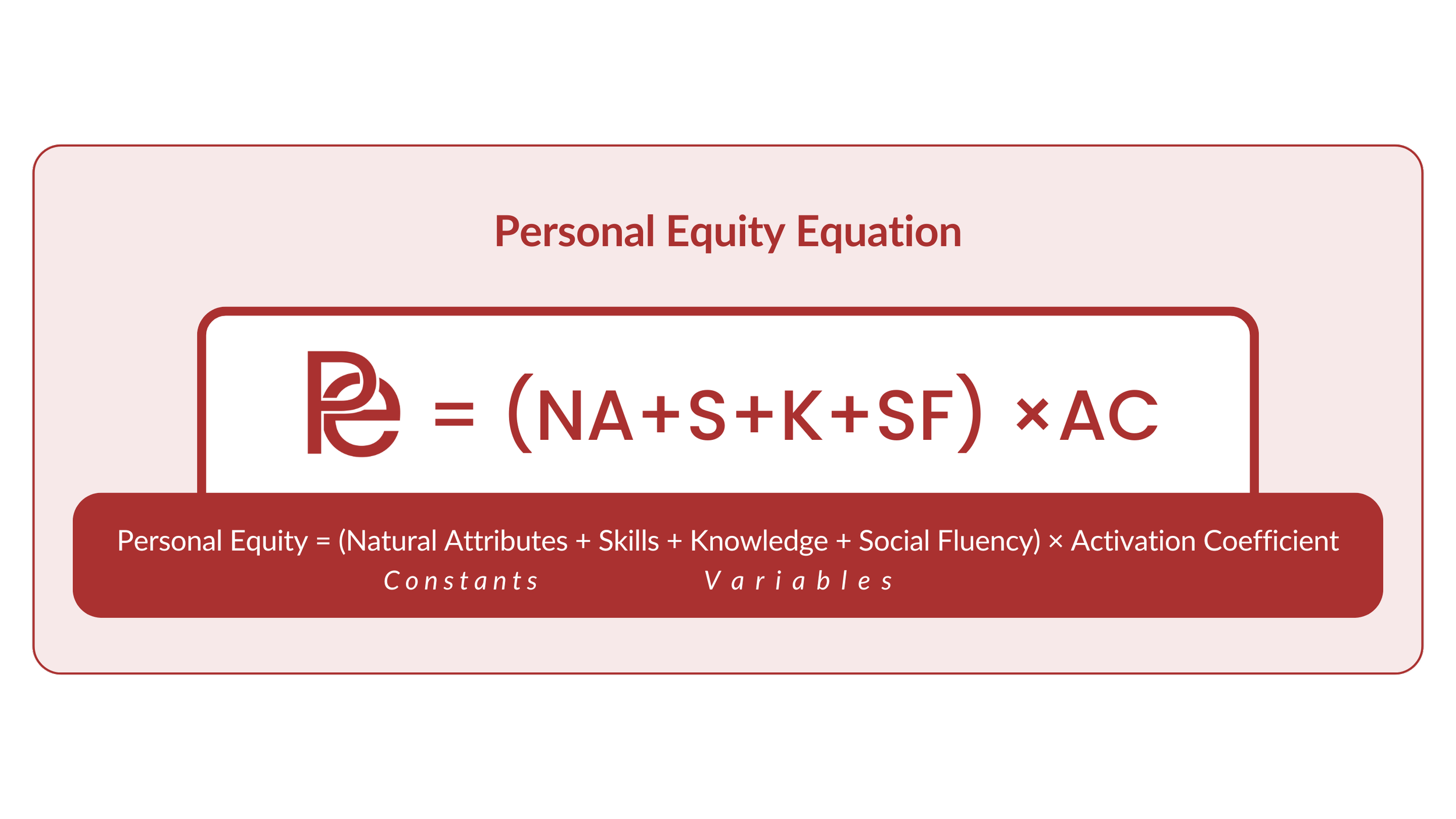
Let’s break that down:
Natural Attributes are your baseline wiring—your innate gifts and default natural abilities, the things that came with you before you started building your resume. These are Constants. Skills, Knowledge, and Social Fluency ( the strategic deployment of your social capital) are what you build over time—competence, context, credibility, relationships. These are your Variables. They grow, compound, and shift as you do. And then there’s Courage: the activation coefficient. The multiplier that determines whether your best selfshows up… or fear does. You can have talent, capital, the brand and a brilliant plan—and still make small, fear-based decisions if Courage is turned down. Think of courage as the volume knob on your Signal. When courage is high, Signal is clear. You lead from alignment. When Courage drops, noise fills the gap — and fear starts making decisions that sound strategic but feel hollow. You've been in that room. You know exactly what I mean.
How noise hijacks your Natural Attributes
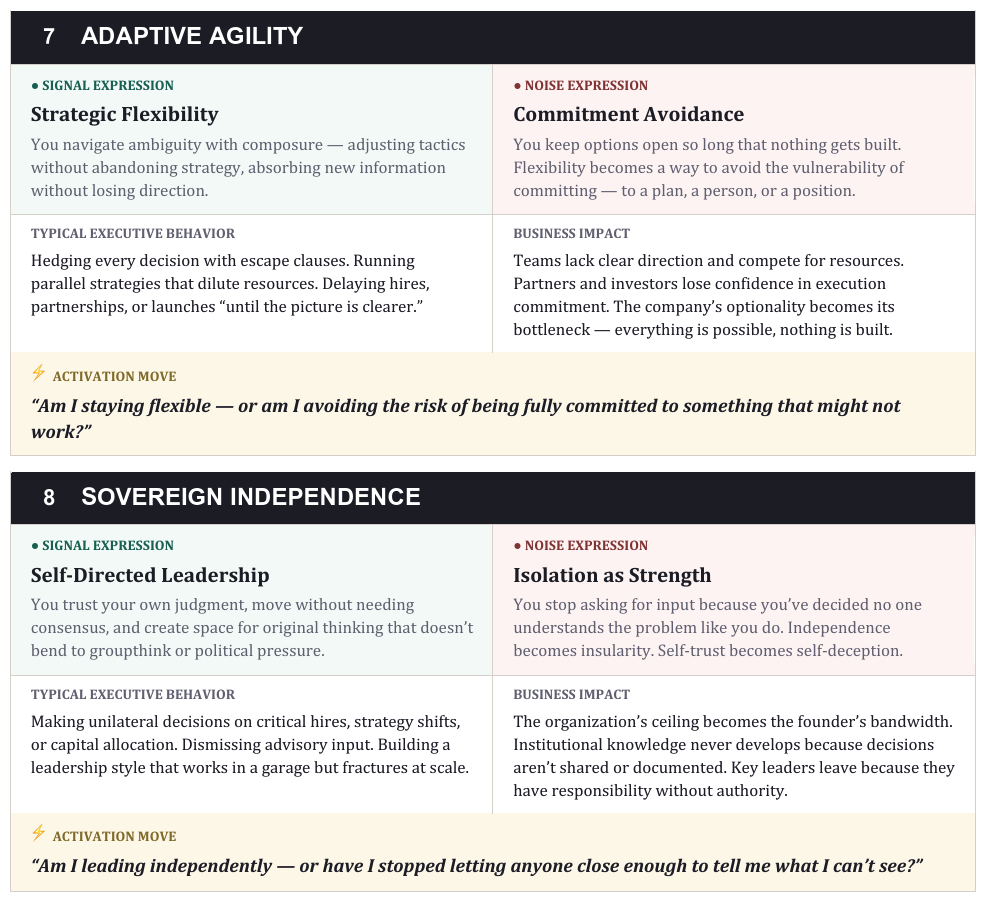
Here's what makes noise dangerous: it doesn't announce itself. It doesn't show up as an obvious enemy. It borrows your best attributes and puts them in service of fear. The same Natural Attributes that make you extraordinary — the ones that built your company, earned your reputation, and drew people to your leadership — can quietly sabotage all of it when they slide into shadow.
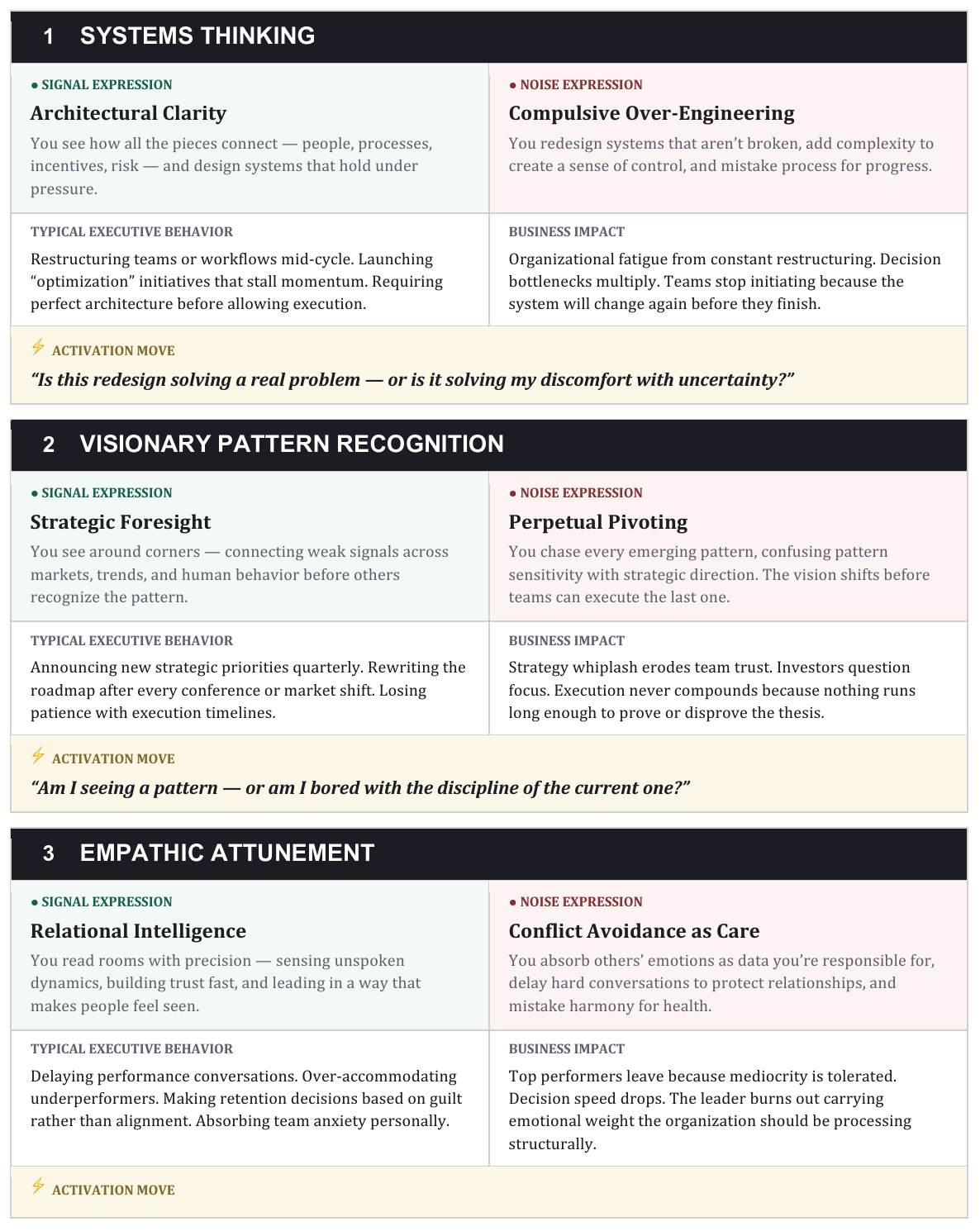
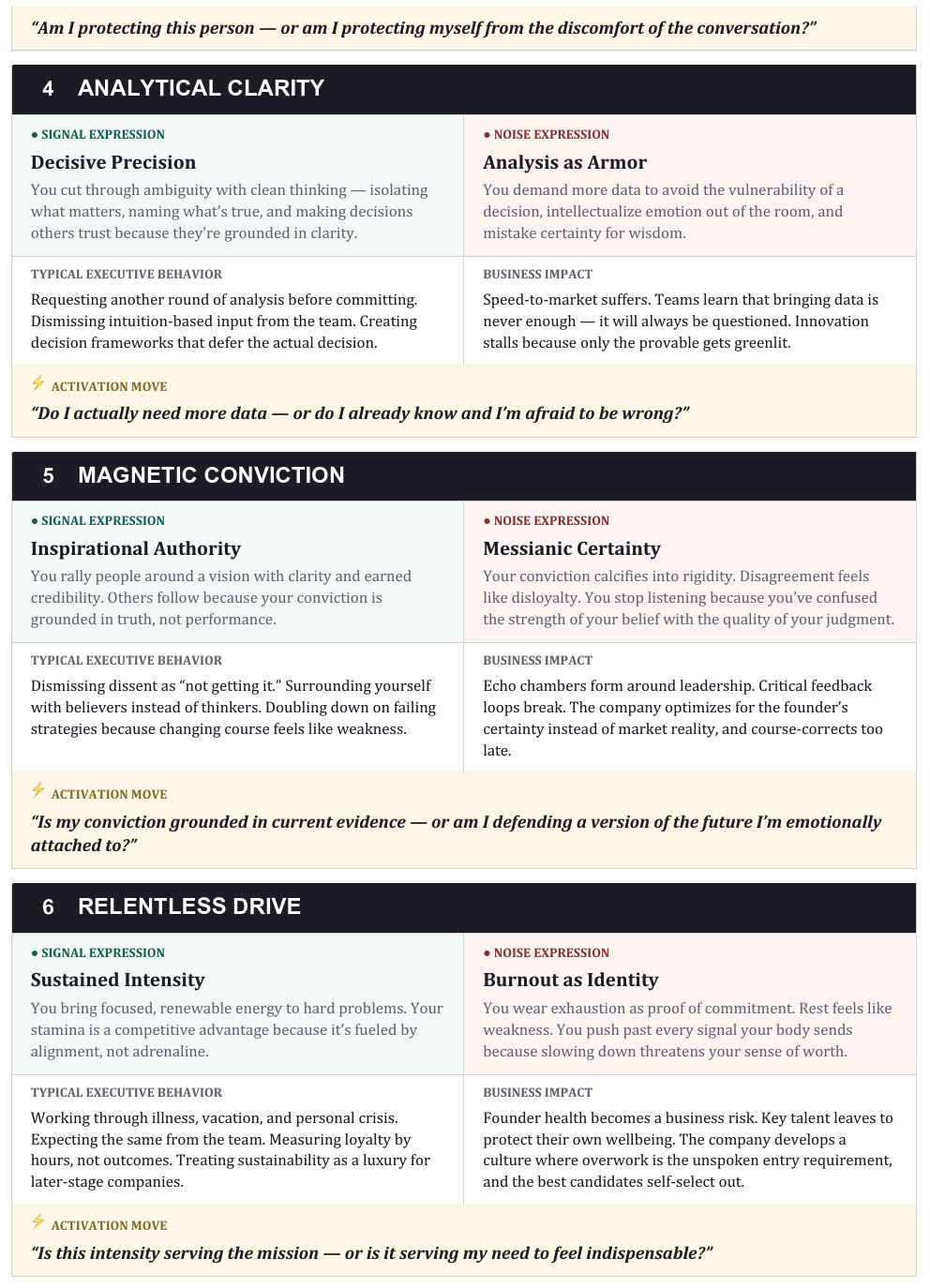
This isn't weakness. It's physics. Every attribute, under enough pressure, has a noise expression. And in highstakes leadership, the pressure is constant. Here are a few examples of natural attributes that commonly show up in leaders of growth-stage companies. For each, you’ll see the “Signal” expression, the “Noise” expression, how it tends to show up in executive behavior, the business impact, and a one-line activation move to go from Noise to Signal.
SOCIAL FLUENCY: DEPLOYMENT OF SOCIAL CAPITAL- THE FREQUENCY RANGE
We've talked about Courage as the volume knob on your Signal. But volume alone isn't enough if you're broadcasting on a narrow band.
Social capital is your frequency range.
Most people think of social capital as networking — collect contacts, attend events, maintain a LinkedIn, social media presence. But for growth-stage leaders, social capital is about building a trust infrastructure. It's trust, deliberately distributed across every stakeholder your company depends on to survive and grow. Trust with your team — so they tell you what's breaking before it breaks publicly. Trust with customers — so they stay through a mistake, not just through a discount. Trust with colleagues — so the best ideas surface and get executed. Trust with suppliers — so resilience exists when supply chains shift. Trust with regulators and communities — so innovation is not on perpetual defense mode. Trust with partners — so collaboration holds when the market get funky.
Here's the business truth: when trust is distributed, risk is absorbed. When trust is concentrated — or missing — every shock becomes a crisis. One bad quarter, one public misstep, one regulatory inquiry, and the whole structure crumbles because there's no relational load-bearing anywhere else.
And here's the societal truth most founders overlook: companies with wide trust networks don't just extract value from the ecosystems they operate in. They stabilize them. That's not charity. That's structural durability. And it's the difference between a company that survives disruption and one that becomes it.
This is where Signal and Noise show up in social capital too. Signal-driven social capital is trust built through consistency, transparency, and aligned action — the kind that compounds quietly over years. Noise-driven social capital is transactional — performative relationships that look impressive on a cap table but evaporate when you need them most. You know which one you have when the crisis arrives.
QUIET STRUCTURAL MOVES THAT MAKE ALIGNMENT REAL
Aligned leadership isn't always loud. In fact, the most durable alignment rarely makes headlines. It lives in quiet structural moves — the decisions that don't get press but change outcomes:
Rewrite incentives so integrity is rewarded, not punished. Change vendor terms so your supply chain reflects your values, not just your margins. Update promotion rubrics so you stop rewarding fear in a suit. Protect the truth-teller — so reality can reach the leadership team. Measure what you claim matters — so values become operational, not ornamental.
These are systems decisions. And systems matter because they hold under pressure and outlast the individual. When you're scaling, your systems are compassion in motion: they protect your people from the whims of mood, fear, and urgency. They ensure alignment doesn't depend on whether the founder/CEO/ C-Suite leader had a good night's sleep.
Think of it this way: if the Personal Equity Framework equation is the diagnostic, these structural moves are the engineering. You've identified the Signal. You've named the Noise. Now you're building the infrastructure so alignment doesn't live in your intentions — it lives in how your company operates.
THE THREE ACTIVATION QUESTIONS
You now have the framework. You can see the equation, name your attributes, and recognize when noise gets loud. Frameworks don't hold in theory. They hold in the room — in real time, when the Noise spikes and fear is palapable.
So here are three Signal filters. Use them when the volume is loudest and your clarity matters most:
1. What would we do if we were optimizing for the next five years, not the next five days? This question cuts through reactive decision-making. It doesn't eliminate urgency — it subordinates urgency to direction.
2. Where is my strongest natural attribute drifting into shadow right now? This is the honest question most leaders skip because it requires admitting that the attribute you're most proud of might be the one doing the most damage today.
3. What system change makes the right decision repeatable — not heroic? Think incentives. Metrics. Governance. Reporting lines. If the right decision requires personal courage every single time, the system is failing. Courage should unlock alignment, not substitute for it.
These questions don't just calm the room.
They recalibrate your signal. And asked consistently, they compound — into trust, into clarity, into the kind of leadership capital that doesn't appear on a balance sheet but determines whether your company endures. That's Personal Equity.
THE CONTRARIAN VIEW: STOP CHASING "AUTHENTICITY"
Here's where I'll lose some of you — and that's fine.
"Be authentic" isn't a strategy. It's a bumper sticker. And under pressure, "authentic" can become reactive, defensive, or self-justifying. "I was just being authentic" has been used to excuse plenty of decisions that served ego, not alignment.
What holds under pressure isn't authenticity. It's alignment.
Because alignment is measurable in decisions: Does this match what we say we value? Does it strengthen long-term trust? Does it create repeatable right action — or does it require a hero every time? 7 Authenticity is a feeling. Alignment is a practice. And practices scale. Feelings don't.
Authenticity is a feeling. Alignment is a practice. And practices scale. Feelings don't.
CHOOSE SIGNAL
The next time Noise tells you to shrink — to protect image over integrity, short-term comfort over long-term trust, the palatable answer over the true one — choose Signal.
Choose the mirror over the mask.
Because courage is aligned action when fear is persuasive. Not the absence of fear. Not the performance of confidence. The decision to act from alignment when every pressure in the room is pulling you toward Noise.
And every time you do, you build a kind of wealth that doesn't vanish in a downturn, doesn't depreciate with a market correction, and doesn't depend on anyone else's permission to exist: Personal Equity — leadership that's good for business, and good for the world it touches.
So here's your move.
This week, pick one decision where you've been managing noise instead of leading from Signal. Turn down the volume. Ask the three questions. Make the structural move. And lead from alignment — not because it's easy, but because it's yours.
© Frame Advisory LLC. All rights reserved.